The decisions that matter most
are often made with incomplete information.
Not because the data doesn't exist — but because it's scattered across public sources you don't monitor, locked in formats you can't process, or simply not being collected.
AI changes what's practical. Data sources that were too fragmented, too high-volume, or too unstructured to use are now accessible.
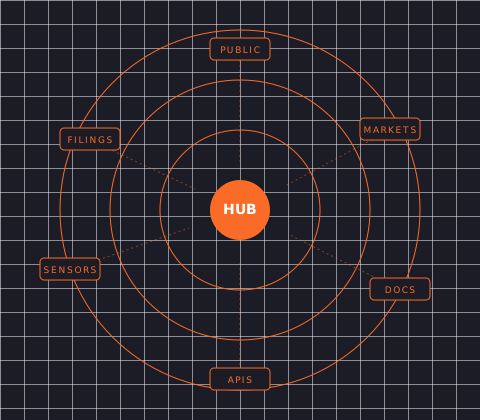
Public datasets, regulatory filings, competitor activity, satellite imagery, IoT sensor feeds, market signals, academic publications, patent filings — all of it can be captured, cleaned, and turned into intelligence.
And it's not just external data. There's often data inside your own business that nobody's collecting.
Decisions you already make —
with signals you don't currently have.
Business development
Word of mouth and personal networks.
Public records — planning applications, procurement notices, regulatory filings, funding announcements — surfaced the day they appear.
Pricing
Quarterly reviews and internal benchmarks.
Competitor pricing, material costs and positioning tracked daily. Periodic exercise becomes continuous advantage.
Operations
Only the data you already collect.
Weather, regulatory changes, supply chain signals and market conditions correlated with internal data — patterns nobody in your business has seen before.
THE GAP WIDENS AS THE PIPELINE CAPTURES MORE DATA
Three conditions. Worth building
where they overlap.
Does it change a decision?
If knowing the information wouldn't alter what your team does, the pipeline isn't worth building.
Is the data obtainable?
Public, available via API, capturable through sensors, or extractable from documents. We map what's available before we build.
Can the pipeline maintain itself?
APIs break. Formats shift. We build pipelines with monitoring, error handling, and automated adaptation.
Decisions based on data
your competitors aren't using.
Continuous intelligence
Data flowing into your business automatically. Not a quarterly report — a live signal.
Informed decisions
Pricing, bidding, hiring, investment — grounded in signals your competitors don't see.
Compounding advantage
An edge that grows over time as the pipeline captures more data and the layer gets smarter.
Strategy, then capture.
Capturing new data typically involves a Lean AI Strategy build (to identify the source and the use case) followed by an AI Service Build (data-capture capability into your stack) or an AI Tool Build (your team using the new data day-to-day).
What data could
change your decisions?
Take the diagnostic. Nine questions. It'll tell you whether new data sources are your highest-impact AI opportunity — and what intelligence you could be capturing.